EIILM-Kolkata Custom WordPress Theme Refactor & Optimization
Refactoring and stabilizing a large custom WordPress education website for better maintainability, security, structured content management and production reliability.
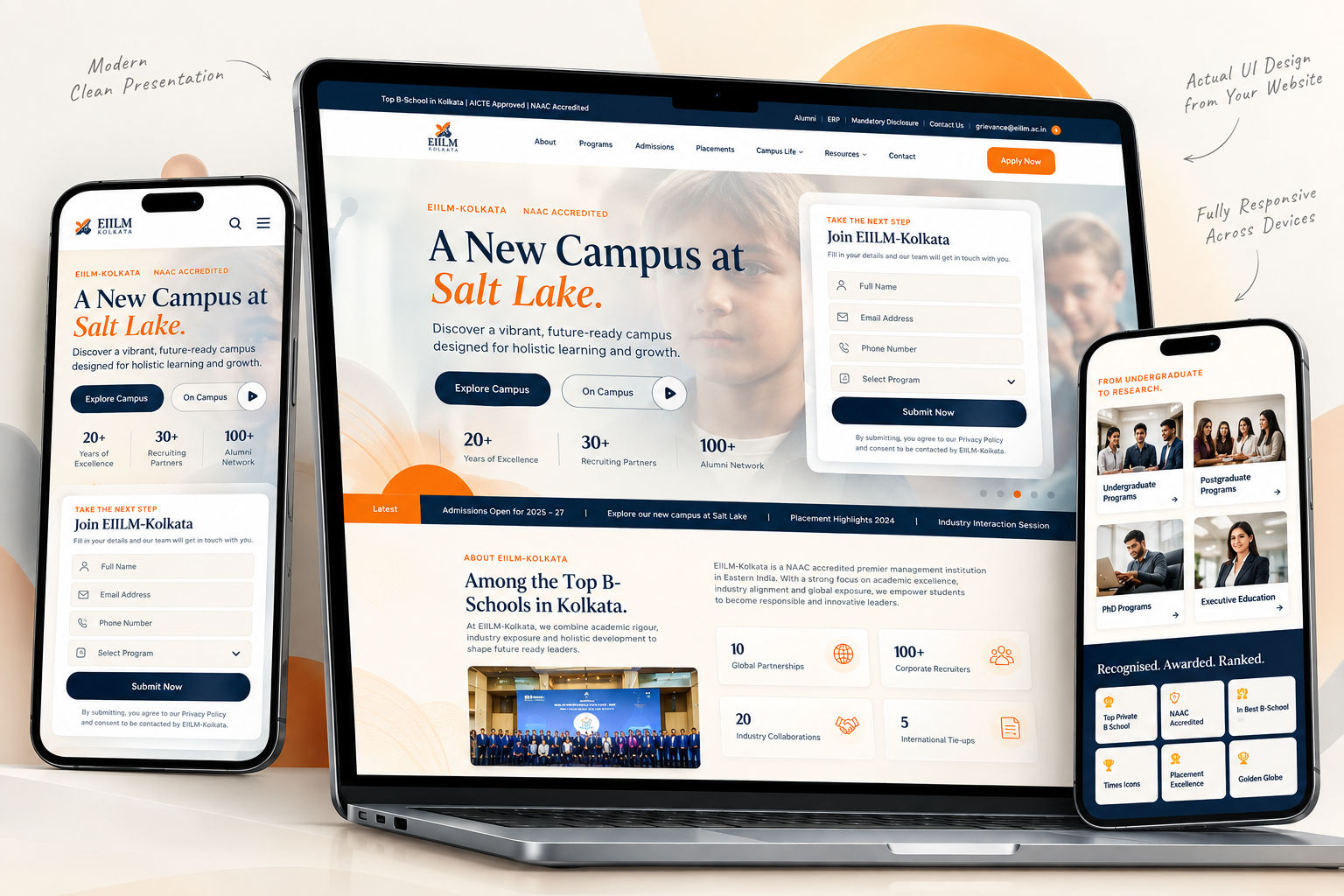
Overview
Webrama.in powers the EIILM-Kolkata website, a content-heavy education platform covering undergraduate, postgraduate and PhD programs, admissions, placements, faculty, mentors, facilities, campuses, institutional partnerships, awards and student-focused information. I worked on the custom WordPress theme with a focus on code quality, maintainability, security and production stability. The existing theme contained significant functionality concentrated inside functions.php, repeated administrative initialization logic, automated content/seeding processes and ACF structures that were difficult to maintain. I audited the theme architecture and reorganized the implementation into cleaner functional modules. This included reducing the responsibility of functions.php, separating ACF and data/seeder-related code, reviewing custom post types and public URL behaviour, checking custom database/query handling, examining form and input security, identifying staging/internal-link issues and improving the overall structure for future maintenance. The result was a significantly cleaner WordPress codebase with clearer separation of responsibilities, easier content administration and a stronger foundation for continued development, debugging, SEO and production deployment.
The Pain Point
The existing custom WordPress theme had accumulated too much functionality inside core theme files, particularly functions.php. ACF fields and administrative logic were difficult to maintain, repeated admin_init operations increased complexity, automated content creation required tighter control, and several custom post types created questions around unnecessary public URLs and long-term SEO management. The project also required a broader production audit covering custom queries, input handling, internal links, forms, staging references, content architecture and maintainability.
Problem Statement
How can a large, custom-built WordPress education website be restructured into a cleaner, safer and more maintainable system without rebuilding the entire site or disrupting its existing content? The challenge was to preserve the existing frontend and institutional content while reducing technical debt, separating responsibilities within the theme, making ACF-driven content easier to manage and reviewing potentially sensitive areas such as custom SQL, forms, WordPress actions and automatically generated content.
Key Features
- Custom WordPress theme architecture
- ACF-powered structured content management
- Modular PHP theme structure
- Custom post type management
- Dynamic academic program pages
- Faculty and staff content management
- Mentor and partner sections
- Multi-campus content architecture
- Facilities and institutional content sections
- Admissions-focused landing content
- Dynamic FAQ management
- Responsive frontend layouts
- Reusable WordPress template structure
- Custom database and query handling review
- WordPress input sanitization and output escaping review
- SEO-conscious content and URL structure
- Internal-link and staging-link QA
- Production deployment and stability review
- Maintainable administrator editing workflow
Process
- 1Reviewed the complete custom WordPress theme architecture
- 2Audited functions.php and identified unrelated responsibilities
- 3Mapped repeated hooks and admin_init operations
- 4Separated large functionality into dedicated PHP modules
- 5Reduced functions.php to approximately 184 lines
- 6Separated ACF-related theme logic
- 7Separated data and content-seeding functionality
- 8Reviewed ACF field organization and administrator editing workflow
- 9Audited custom post types and their public URL requirements
- 10Reviewed Mentors, Facilities, Committees, Faculty & Staff, Awards, Campuses and FAQ content structures
- 11Checked custom WordPress queries and database interactions
- 12Reviewed $wpdb usage and parameterized query handling
- 13Checked sanitization, validation and escaping practices
- 14Reviewed forms and user-controlled input paths
- 15Checked nonce and capability requirements for sensitive actions
- 16Reviewed the website for staging and local-development links
- 17Checked internal linking and production URLs
- 18Reviewed SEO implications of unnecessary CPT single pages
- 19Tested frontend content and responsive behaviour
- 20Reviewed WordPress Site Health and production configuration
- 21Prepared the refactored theme for deployment
- 22Deployed and validated the website on production hosting
The Outcome
The refactor transformed the theme from a tightly coupled implementation into a more maintainable WordPress architecture. functions.php was reduced to approximately 184 lines by separating major functionality into dedicated modules. ACF and data-related logic became easier to understand and maintain, custom post type behaviour was reviewed from both development and SEO perspectives, and database/input handling received a dedicated security review. The project created a stronger foundation for future development, debugging, content updates, SEO improvements and production maintenance while reducing the risk of changes in one part of the theme affecting unrelated functionality.
My Role
WordPress Developer | Custom Theme Audit, Refactoring, Security Review & Production Optimization
Timeline
September 2026
Related Work
Looking for similar work?
If you need a developer who understands your tech stack and can deliver results like this, let's talk.