AI Website Builder vs Custom Developer: What Nobody Tells You Before You Choose (2026)
Weighing AI website builder vs custom developer for your business? Here's what actually happens six months after launch, and how to know which side you're really on.

Debajoyti Paul
Design Engineer
July 31, 2026
6 min read
You typed "AI website builder for small business" into Google at 11pm, half-hoping the answer would just be "yes, do it, save your money." Or maybe you typed "why does my AI-built website look like everyone else's" after your site had already been live for three months. Either way, you're not being paranoid, you're just trying to answer the AI website builder vs custom developer question before you've spent money, not after.
Here's the honest version of that answer, from someone who builds both the fast no-code sites and the fully custom ones, and has watched business owners get burned going either direction.
What AI website builders actually get right
Let's not pretend this is a scam. Tools like Lovable, Framer AI, and the new wave of prompt-based builders solve a real problem: speed. You describe your business, and in fifteen minutes you have a live, mobile-responsive site with copy, layout, and images already in place. For a solo consultant who needs a credible landing page by Friday, that's genuinely useful. No blank canvas, no waiting three weeks for a first draft, no five-figure invoice.
If your business is simple, one service, one location, one call-to-action, an AI builder can absolutely get you live and looking professional. Nobody serious in this industry should tell you otherwise.
Where it quietly costs you later
The part nobody puts in the marketing copy is what happens after launch, once the business starts depending on that site.
You don't own the site, you own the content. Most AI builders keep your design and infrastructure locked inside their platform. If you want to move hosts, add a custom feature, or the platform changes its pricing overnight, you're not migrating, you're rebuilding from scratch. That's paying for the same website twice.
The moment you hand-edit the code, the AI stops helping you. Several of these tools break their own "auto-update" magic the first time a human touches the generated code directly. What's left is a tangled file no developer wants to inherit, because nobody, including the AI, fully understands why it's structured the way it is.
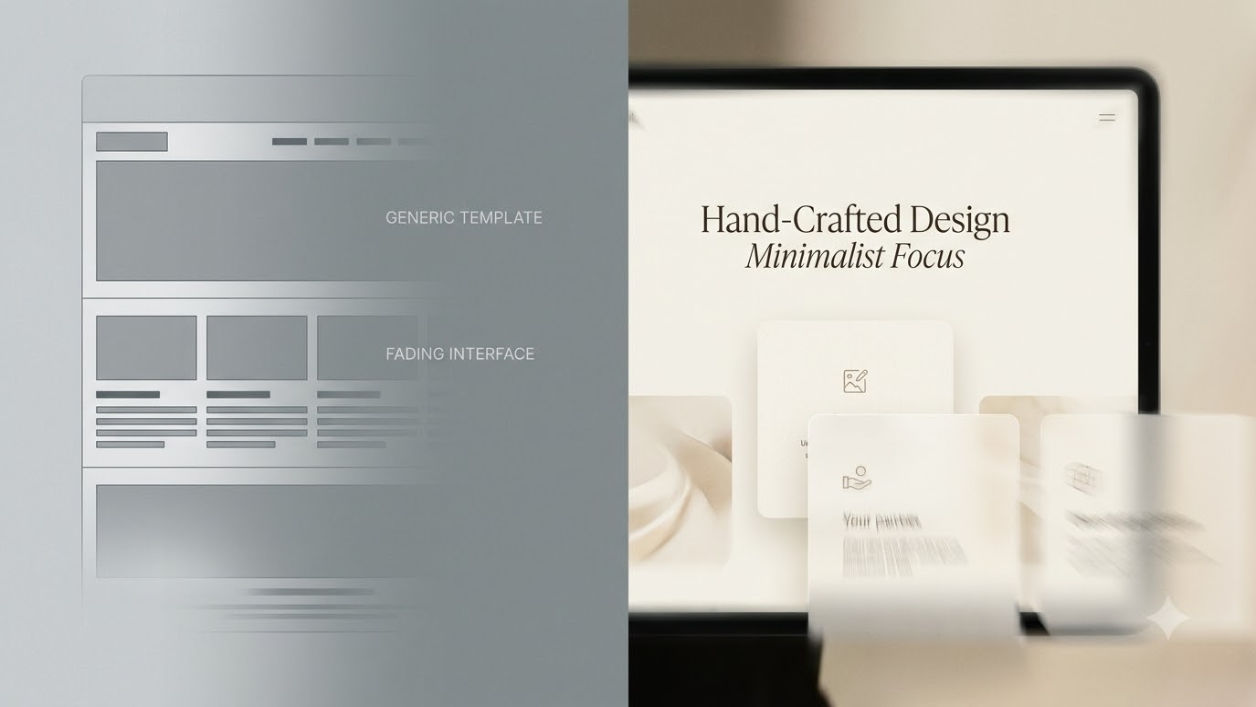
Generic is the default, not the exception. When thousands of businesses prompt the same handful of AI models with similar requests, they get variations of the same layout, the same section order, the same visual rhythm. Your site can look "done" and still fail to look like you, and for a business that competes on trust and brand feel, that's a real cost, not a cosmetic one.
It has a ceiling on complexity. The moment your business needs something specific, a booking flow tied to your actual calendar, a dashboard your team logs into, a design system with real brand rules, you hit the edge of what the template library can flex to. AI builders are excellent at "good enough, fast." They're not built for "exactly right, for us."
The SEO and conversion gap nobody mentions
Here's the part that matters most if your website's actual job is to bring in customers, not just exist. Ranking and converting aren't the same skill as "looking finished."
AI builders are getting better at basic on-page SEO: titles, meta descriptions, alt text, that layer is mostly solved now. What they can't do is make strategic decisions about your content structure, which pages you actually need for your specific buyer's journey, what your competitors are ranking for that you're not, or how to structure copy so a visitor takes the exact next step you want. A template can hold your words. It can't tell you which words are costing you the sale.
Conversion is where the gap shows up fastest. Two businesses with near-identical offers and near-identical prices will get very different results depending on whether the page was built to move a specific visitor toward a specific action, or assembled from a generic block library that was never tested against your actual audience. That difference is invisible in a screenshot and very visible in your analytics three months in.
None of this means AI-generated sites can't rank or convert at all, plenty do fine for simple, low-competition niches. It means the ceiling is lower, and you often don't find out where that ceiling is until you've already hit it.
AI website builder vs custom developer: the gut-check framework
Before you pick a side, run your business through these four questions honestly:
Is your offer simple and single-purpose? One service, one audience, one CTA means an AI builder is fine to start.
Does your brand carry real weight in your pricing? If people pay you more because of how premium you look and feel, template-based design quietly undercuts that.
Will this site need to grow with you, bookings, logins, integrations, a blog you actually control? Custom development pays for itself the moment "simple" stops being true.
Are you planning to keep this site for years, or relaunch in six months anyway? If it's a placeholder, don't overbuild it. If it's meant to be your business's home for the next three to five years, build it like one.
The middle path most people never hear about
This isn't actually a binary choice, and treating it like one is how both AI-builder fans and "always go custom" developers oversell their side.
A lot of my own client work sits in that middle ground on purpose. I build custom WordPress themes from scratch specifically so a business gets a fast, editable site without being locked into a bloated page builder or an AI platform's ecosystem, so you get speed and ownership together. On the fully custom end, I work with React and Next.js, using an open-source component library I maintain myself, Reline, which lets me move at near-AI speed on the frontend without handing a client a black box of machine-generated code nobody can maintain.
The honest advice: start where your business actually is today, not where you hope it'll be in a year. If an AI builder gets you live this week and validates the idea, that's a smart, cheap first step, as long as you go in knowing it's a first step, not a permanent foundation. The businesses that get hurt are the ones that don't realize they've outgrown the tool until a competitor with a sharper, faster, more trustworthy site is already eating their leads.
If you're at the point where your website needs to actually convert, scale, and reflect a business people trust with their money, that's a different conversation than "get something live by Friday." Happy to look at where you are and tell you straight which side of that line you're actually on.
Related Reading
How to Choose the Right Web Development Solution for Your Business (Without Getting Burned)
Three quotes, three prices, zero questions asked. Here's how to evaluate a web development solution for your business before you sign off on one.
Is Your Website a Security Risk? What Small Business Owners Actually Need to Check
Is your website a security risk? Most small business owners have never once checked. Here's what actually makes a site vulnerable, what it costs if it goes wrong, and the 10-minute audit you can run today.
Written by
Debajoyti Paul
Freelance design engineer with 3+ years building high-converting Next.js and WordPress sites for startups and small businesses.
More about me →